Texas DWI Community Supervision: What You Need to Know
Community supervision is the official Texas legal term for probation, defined under Chapter 42A of the Texas Code of Criminal Procedure as a court-ordered sentence that allows a DWI offender to remain in the community instead of serving time in jail. If you are facing a DWI charge in Montgomery County or anywhere in Texas, understanding what community supervision means, how it works, and what it demands of you is the most practical step you can take right now. This is not a free pass. It is a structured criminal sentence with real consequences for non-compliance.
What is community supervision for a Texas DWI?
Community supervision for a Texas DWI is a formal probation sentence governed by Texas Code of Criminal Procedure Chapter 42A, which sets out every rule from how conditions are imposed to how violations are handled. The term “community supervision” and “probation” are used interchangeably in Texas courts, but the statute uses “community supervision” as the precise legal label. Knowing this distinction matters because your paperwork, court orders, and any legal motions filed against you will use that exact language.
The core idea is straightforward. Instead of sending you to jail, the court allows you to live and work in the community while you fulfill a specific set of conditions. Those conditions are not optional suggestions. They are court orders, and breaking them carries the same weight as violating any other judicial directive.

Community supervision is a criminal sentence that demands strict adherence. Many people make the mistake of treating it as a lighter outcome than conviction, when in reality it is a sentence that can convert to incarceration at any point if you fail to comply.
What are the types of community supervision for Texas DWI offenders?
Texas DWI cases use two distinct forms of community supervision, and the difference between them has major long-term consequences for your record and your freedom.
Straight (regular) community supervision
Straight community supervision follows a formal conviction. The judge enters a guilty verdict, then suspends the jail sentence and places you on probation instead. The conviction appears on your permanent criminal record from day one. If you complete all conditions successfully, the sentence is satisfied, but the conviction remains. This is the more common outcome for first-time DWI offenders who do not qualify for deferred adjudication or who choose to resolve the case through a plea.
Deferred adjudication
Deferred adjudication delays the conviction entirely. You enter a guilty or no-contest plea, but the judge withholds a finding of guilt and places you on supervision. If you complete every condition without violation, the case is dismissed and no conviction is ever entered. This sounds significantly better, and for many offenses it is. However, Texas law restricts deferred adjudication for DWI cases. A first-time DWI offender may be eligible, but repeat offenders generally are not.
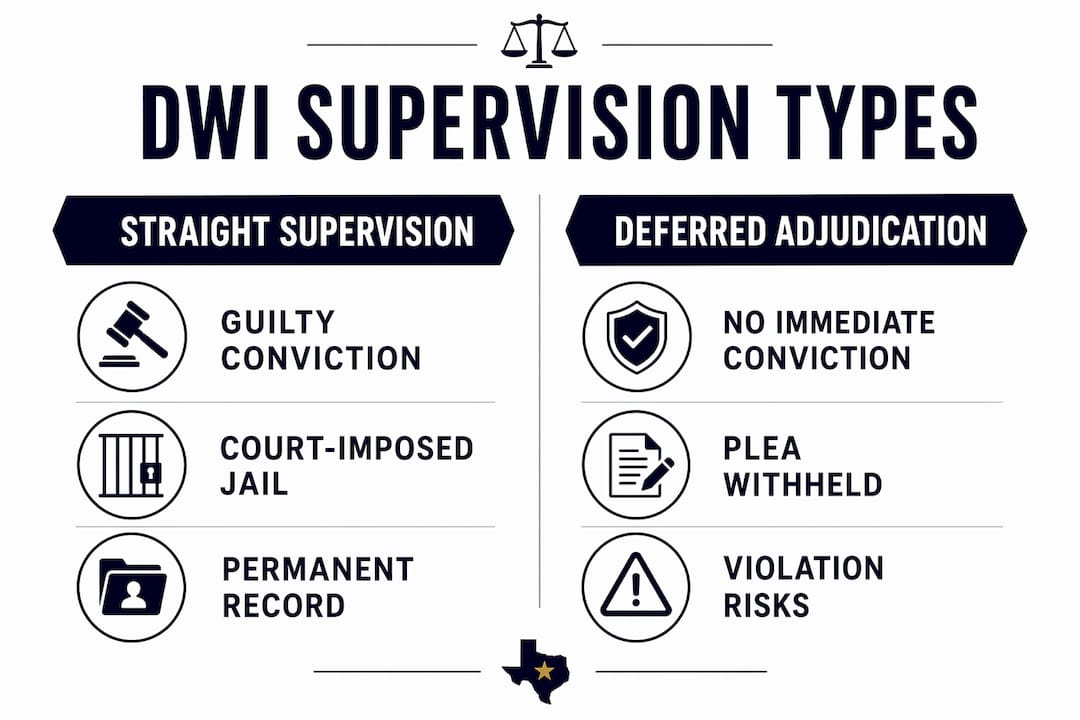
The critical risk with deferred adjudication is that any violation can trigger immediate conviction and exposure to the full original sentence. The judge is not limited to a modified term. They can impose the maximum statutory penalty. That risk is real and often underestimated.
| Feature | Straight supervision | Deferred adjudication |
|---|---|---|
| Conviction on record | Yes, from day one | No, unless violated |
| Dismissal possible | No | Yes, upon completion |
| Violation consequence | Revocation, jail exposure | Conviction plus full sentence |
| Eligibility for first DWI | Yes | Possible, case-dependent |
Pro Tip: If deferred adjudication is offered to you, do not accept it without fully understanding that a single technical violation can result in a conviction and maximum sentence. Consult a qualified DWI attorney before agreeing to any supervision terms.
What are the common conditions during DWI community supervision in Texas?
Court-ordered conditions for Texas DWI supervision are specific, measurable, and monitored. Missing even one requirement can trigger a violation proceeding. Here is what you will typically be required to do:
- Report regularly to a supervision officer. Most DWI probationers report monthly in person, though the frequency can increase based on risk level or prior violations.
- Complete a DWI education program. Texas requires completion of an approved DWI intervention or education course, typically 12 hours for a first offense.
- Perform community service hours. The court orders between 24 and 100 hours of community service for a standard DWI. Higher BAC levels or aggravating factors push that number toward the upper end.
- Install an ignition interlock device (IID). An IID requires a breathalyzer test to start your vehicle and conducts random rolling retests while you drive. All data is transmitted to your probation officer. A failed test or a missed test is treated as a violation.
- Abstain from alcohol and controlled substances. You will be subject to random urinalysis and breath testing. Any positive result is a violation.
- Avoid new criminal offenses. Any new arrest, even for an unrelated charge, can trigger a revocation proceeding.
- Pay all fines, court costs, and monthly supervision fees. Fees vary by county but typically range from $60 to $100 per month in addition to court-assessed fines.
Pro Tip: Keep written records of every payment, every community service hour, and every IID maintenance appointment. If a dispute arises with your supervision officer, documentation is your best defense.
The IID requirement deserves special attention. Probation officers treat IID compliance as one of the primary indicators of whether a DWI offender is genuinely following the terms of supervision. A pattern of failed tests or missed calibration appointments signals non-compliance and often triggers a formal review before any other condition is examined.
What happens if you violate community supervision terms for a Texas DWI?
Violations fall into two categories: technical violations and new criminal offenses. A technical violation is a failure to meet a supervision condition, such as missing a reporting appointment, failing to pay fees, or testing positive for alcohol. A new criminal offense is any arrest or charge that occurs while you are on supervision.
The process after a violation is reported follows these steps:
- Your supervision officer files a report documenting the alleged violation and submits it to the court.
- The prosecutor files a Motion to Revoke (for straight probation) or a Motion to Adjudicate (for deferred adjudication). Both motions ask the judge to take action against you.
- A revocation hearing is scheduled. You have the right to appear and contest the allegations.
- The judge applies a preponderance of evidence standard. This is a lower bar than the “beyond a reasonable doubt” standard used at trial. The state only needs to show it is more likely than not that you violated the terms.
- The judge issues a ruling. Possible outcomes include continuation of supervision with no change, modification of conditions to add stricter requirements, or full revocation with imposition of a jail or prison sentence.
A revocation hearing is not a criminal trial, but the consequences can be just as serious. The lower proof standard means the state has a significant advantage, and the judge has broad discretion in deciding your outcome.
For deferred adjudication cases, the stakes are higher. A successful Motion to Adjudicate converts your case to a conviction and opens the door to the maximum statutory penalty. A Montgomery County DWI attorney with experience in revocation hearings can challenge the evidence and argue for the least restrictive outcome.
How long does Texas DWI community supervision last?
Misdemeanor DWI community supervision typically runs up to two years, though the exact term is set by the judge at sentencing. A first-time DWI with a BAC just above the legal limit may result in a 12-month term. A higher BAC, an accident, or a prior record can push the term to the full two years. Felony DWI cases, such as a third DWI or intoxication assault, carry longer supervision periods that can extend up to 10 years.
| Offense type | Typical supervision length | Early termination allowed? |
|---|---|---|
| First misdemeanor DWI | 6 months to 2 years | No (straight probation) |
| First DWI, deferred adjudication | 6 months to 2 years | Yes, by petition |
| Felony DWI | Up to 10 years | Possible, with conditions |
Early termination is generally prohibited for straight probation in Texas DWI cases. The statute restricts the court’s ability to discharge a straight probation sentence before the full term is served. Deferred adjudication is different. After demonstrating consistent compliance and serving a meaningful portion of the term, you can petition the court for early discharge. The judge has discretion to grant or deny that petition.
The IID requirement often runs for the full supervision period or until the court orders its removal. Ending your IID obligation early requires a separate motion and a showing of compliance. Your supervision officer’s recommendation carries significant weight in that decision.
Key takeaways
Community supervision for a Texas DWI is a court-ordered criminal sentence with strict conditions, two distinct legal forms, and serious consequences for any violation.
| Point | Details |
|---|---|
| Legal definition | Community supervision is Texas probation under Chapter 42A, not a lenient alternative to conviction. |
| Two supervision types | Straight probation carries an immediate conviction; deferred adjudication delays conviction but risks maximum penalties if violated. |
| Core obligations | Reporting, DWI education, 24 to 100 hours of community service, IID installation, abstinence, and monthly fees are standard conditions. |
| Violation consequences | A judge uses a preponderance of evidence standard and can revoke supervision and impose the original jail sentence. |
| Supervision length | Misdemeanor DWI terms run up to two years; early termination is barred for straight probation but possible for deferred adjudication. |
What I’ve learned about community supervision after years of DWI defense
Most people who come to me after a DWI arrest focus entirely on whether they will go to jail that day. What they underestimate is how demanding the months or years that follow can be. Community supervision sounds like a relief in the moment, and it is. But it is also a long-term commitment that requires consistent attention, organization, and discipline.
The clients I have seen struggle most are the ones who treat deferred adjudication as a guaranteed clean slate. It is not. The “no conviction yet” status is fragile. I have watched cases where a single missed IID calibration appointment, something that takes 20 minutes to handle, triggered a motion to adjudicate and put a client at risk of the maximum sentence. That outcome is preventable, but only if you understand the stakes from the beginning.
My honest advice: read every condition in your supervision order before you leave the courthouse. Do not assume your supervision officer will remind you of deadlines. Set calendar alerts for every reporting date, every fee payment, and every IID service appointment. And if something goes wrong, contact an attorney before your next supervision meeting, not after.
The clients who complete supervision successfully are not the ones who got lucky. They are the ones who treated every condition as non-negotiable from day one.
— Gregg
Facing DWI community supervision in Montgomery County?
If you are navigating a DWI charge or already on community supervision in Montgomery County, having experienced legal counsel makes a measurable difference in your outcome. Dwimontgomery, led by former Texas Judge and Prosecutor Mike Seiler, handles every stage of DWI defense, from the initial charge through supervision compliance and violation hearings.

Whether you are facing a first-time DWI, a felony charge, or a revocation hearing after a supervision violation, the team at Dwimontgomery understands how Texas courts approach these cases from the inside. If you or someone you know is dealing with a serious charge like intoxication assault in Montgomery County, do not wait to get qualified representation. Contact Dwimontgomery today for a direct consultation with an attorney who knows this system.
FAQ
What is community supervision in a Texas DWI case?
Community supervision is the Texas legal term for probation, governed by Chapter 42A of the Texas Code of Criminal Procedure. It allows a DWI offender to serve their sentence in the community under court-ordered conditions instead of in jail.
What is the difference between straight probation and deferred adjudication for DWI?
Straight probation follows a formal conviction that appears on your permanent record. Deferred adjudication delays the conviction and can result in dismissal if all conditions are met, but any violation exposes you to the maximum statutory sentence.
How long does DWI community supervision last in Texas?
For a misdemeanor DWI, supervision typically lasts between six months and two years, set by the judge at sentencing. Felony DWI supervision can extend up to 10 years depending on the offense.
Can community supervision be terminated early for a Texas DWI?
Early termination is generally not allowed for straight probation under Texas law. If you are on deferred adjudication, you may petition the court for early discharge after demonstrating consistent compliance over a meaningful portion of the term.
What happens if you violate DWI community supervision in Texas?
The state files a Motion to Revoke or Motion to Adjudicate, and a hearing is held where the judge applies a preponderance of evidence standard. Consequences range from modified supervision conditions to full revocation and imposition of the original jail sentence.
Recommended
- How to Clear a DWI Warrant in Texas: 2026 Guide
- Underage DUI Lawyer in Montgomery County | Minor DWI Defense – The Seiler Law Firm
- Underage DUI – The Seiler Law Firm
- Montgomery County DWI Lawyer | Former Judge Mike Seiler – The Seiler Law Firm