What Is Ineffective Assistance of Counsel in DWI Cases?
Ineffective assistance of counsel is a constitutional claim that your DWI defense attorney’s performance fell below professional standards and that failure directly harmed the outcome of your case. Formally established by the U.S. Supreme Court in Strickland v. Washington, this doctrine gives defendants a legal path to challenge convictions when their attorney made serious, outcome-changing errors. In Texas DWI cases, understanding what constitutes ineffective counsel is not just academic. It can mean the difference between a conviction that stands and one that gets overturned or retried. This guide explains the legal standard, how it applies to Texas DWI defendants, and what you can do if you believe your attorney failed you.
What is ineffective assistance of counsel in a DWI case?
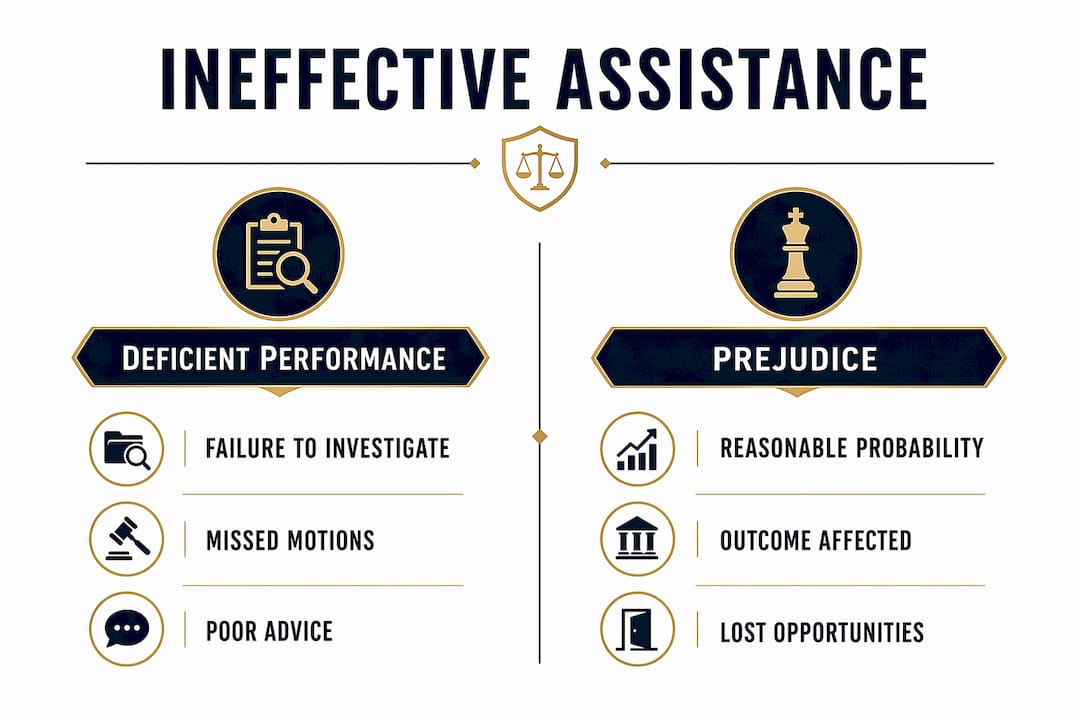
The legal term for this claim is “ineffective assistance of counsel,” and it is grounded in the Sixth Amendment right to effective legal representation. The two-prong Strickland test requires a defendant to prove two things: first, that the attorney’s performance was deficient, meaning it fell below an objective standard of reasonableness based on prevailing professional norms; and second, that this deficiency caused actual prejudice, meaning there is a reasonable probability the outcome would have been different without the errors. Both prongs must be satisfied. Proving one without the other is not enough.
The prejudice prong is where most claims fail. Showing a bad result is not enough. You must show that counsel’s specific errors actually affected the outcome, not just that the trial went poorly. This distinction filters out claims based on hindsight or general dissatisfaction with a lawyer’s style.

When a DWI case ends in a guilty plea rather than a trial, the standard shifts slightly. Under Hill v. Lockhart, the prejudice analysis focuses on the plea decision itself. You must show that but for counsel’s errors, you would not have accepted the plea and would have chosen to go to trial instead. This is a meaningful distinction because many Texas DWI cases resolve through plea agreements.
The strong presumption courts apply
Courts begin every ineffective assistance analysis with a strong presumption that the attorney acted within reasonable professional norms. Strategic decisions made after adequate investigation are virtually unchallengeable, even if those decisions turned out to be wrong. This presumption exists to prevent defendants from second-guessing every tactical call their lawyer made. To overcome it, you need concrete evidence that the attorney’s conduct was not a reasonable strategy but an actual failure.
Pro Tip: Document every interaction with your attorney, including what advice they gave you before a plea, what motions they said they would file, and what witnesses they promised to call. These records become critical evidence in any future ineffective assistance claim.
How do these claims play out in Texas DWI cases?
Texas DWI cases involve specific procedural and evidentiary issues that shape how ineffective assistance claims are built and argued. The most common attorney errors in DWI defense fall into several categories:
- Failure to challenge blood or breath test results. In Goldman v. Florida, failure to challenge blood evidence and the absence of an expert toxicologist supported a finding of ineffective assistance. Texas DWI cases frequently hinge on BAC readings, and an attorney who does not scrutinize testing protocols, chain of custody, or calibration records may be leaving the most important defense unused.
- Neglecting suppression motions. If the traffic stop lacked reasonable suspicion or the arrest lacked probable cause, a motion to suppress can eliminate key evidence. An attorney who fails to investigate and file this motion when the facts support it is not making a strategic choice. That is a deficiency.
- Uninformed guilty pleas. When a lawyer gives incorrect or incomplete advice about the consequences of a plea, and the defendant accepts a deal they would have rejected with accurate information, that is a textbook application of the Hill v. Lockhart prejudice standard.
- Absent or unprepared counsel at critical stages. An attorney who appears at sentencing without reviewing the case file, or who fails to object to improper evidence during trial, creates a record of deficiency that courts take seriously.
Pro Tip: If your DWI case involved a blood draw, ask whether your attorney ever requested the lab’s calibration logs, analyst credentials, or chain of custody documentation. If the answer is no and no strategic reason exists for that omission, you may have the foundation of a claim.
Here is a quick comparison of the two main contexts where ineffective assistance claims arise in Texas DWI cases:
| Context | What you must prove |
|---|---|
| Trial conviction | Deficient performance plus reasonable probability of a different trial outcome |
| Guilty plea conviction | Deficient advice plus proof you would have rejected the plea and gone to trial |
Why are these claims hard to win on direct appeal in Texas?
Direct appeals in Texas are confined to the trial record, which is sometimes called the “four corners” of what was documented in court. Texas appellate courts cannot evaluate unrecorded attorney decisions, such as why certain motions were never filed or why specific witnesses were never called, without an expanded evidentiary record. This is the core reason why most ineffective assistance claims fail on direct appeal.
The practical consequences of this limitation are significant:
- The appellate court sees only what happened in the courtroom, not what the attorney failed to do outside of it.
- Without a record showing the attorney’s reasoning, the court presumes a reasonable strategy existed.
- Errors that occurred during case preparation, client counseling, or plea negotiations are invisible to a direct appeal court.
- Even obvious-looking failures may be upheld if the attorney’s reasoning was never placed on the record.
Direct appeals rarely succeed on ineffective assistance grounds in Texas for exactly this reason. The appellate court is not in a position to hold a hearing, take new testimony, or review documents that were never introduced at trial. Rare exceptions exist when the incompetence is so apparent from the trial record itself that no reasonable strategy could explain it, but those cases are uncommon.
What are common examples of ineffective assistance in DWI defense?
Recognizing what attorney errors actually look like in practice helps you assess whether your situation may support a claim. The following table outlines common DWI defense errors and their potential impact:
| Attorney error | Why it may constitute ineffective assistance |
|---|---|
| No challenge to breathalyzer calibration | BAC evidence may have been suppressed or weakened with proper scrutiny |
| Failure to retain a toxicology expert | Jury receives only the prosecution’s scientific narrative without rebuttal |
| Incorrect plea advice on license consequences | Defendant accepts a deal without understanding the full impact on driving privileges |
| No investigation of the traffic stop | Unlawful stop could have led to suppression of all evidence gathered afterward |
| Unprepared cross-examination of arresting officer | Field sobriety test errors and procedural violations go unchallenged |
The most damaging errors are often the ones that never appear in the trial transcript. An attorney who never requested the police dashcam footage, never interviewed the arresting officer’s supervisor, or never consulted a field sobriety test expert leaves gaps in the defense that are hard to see from the outside but devastating in outcome.
Pro Tip: If you pled guilty to a DWI in Texas and later learned that the traffic stop may have been unlawful, consult a post-conviction attorney. Under Hill v. Lockhart, you may be able to argue that proper advice about the suppression issue would have changed your plea decision.
What steps can you take if you believe your DWI lawyer was ineffective?
If you believe your attorney’s errors affected your DWI case, here is how to pursue relief in Texas:
-
Consult a post-conviction attorney immediately. Not every criminal defense lawyer handles post-conviction work. You need someone with specific experience in Texas habeas corpus proceedings and ineffective assistance claims. Time limits apply, so do not wait.
-
File a post-conviction habeas corpus petition. In Texas, Article 11.07 of the Code of Criminal Procedure governs habeas petitions for felony convictions. Habeas proceedings allow new evidence including affidavits, expert testimony, and explanations from your original attorney that were never part of the trial record. This is the proper venue for most ineffective assistance claims.
-
Gather all supporting documentation. Collect your original attorney’s file, any written communications, plea paperwork, and records of what advice you received. If witnesses can testify about what your attorney told you or failed to do, their affidavits will be valuable.
-
Obtain an affidavit from your original attorney. Texas courts often require the original attorney to explain their reasoning. If the attorney cannot provide a credible strategic justification for the challenged conduct, that silence strengthens your claim.
-
Work with your new attorney to build the expanded record. The goal of a habeas petition is to place before the court everything the trial record missed. This includes expert analysis of the BAC evidence, testimony about what a competent DWI attorney would have done differently, and documentation of the prejudice you suffered.
Understanding your rights after a DWI arrest in Montgomery County is the foundation for any post-conviction strategy.
Key takeaways
Ineffective assistance of counsel in a Texas DWI case requires proving both deficient attorney performance and actual prejudice to the outcome, with most claims best pursued through a post-conviction habeas petition rather than direct appeal.
| Point | Details |
|---|---|
| Two-prong Strickland standard | You must prove deficient performance and resulting prejudice; one prong alone is never enough. |
| Plea cases use Hill v. Lockhart | For guilty pleas, prove you would have rejected the deal but for counsel’s errors. |
| Direct appeal is rarely the right path | Texas courts are limited to the trial record, which rarely captures attorney omissions. |
| Habeas corpus opens the door | Article 11.07 petitions allow new evidence, affidavits, and expert testimony unavailable on appeal. |
| Common DWI errors are often invisible | Failures to challenge BAC evidence or file suppression motions may never appear in the trial transcript. |
Why building the record is the whole game
After years of watching ineffective assistance claims succeed and fail in Texas courts, the pattern is clear. The claims that win are not necessarily the ones with the most dramatic attorney failures. They are the ones with the most complete evidentiary record outside the trial transcript.
Defendants often come to post-conviction counsel frustrated that their original attorney “did nothing.” But frustration is not evidence. What wins habeas petitions is a detailed affidavit from an expert DWI attorney explaining exactly what a competent lawyer would have done differently, combined with documentation showing the outcome would have changed. That combination is what courts respond to.
The other mistake I see regularly is defendants who pled guilty focusing their claim on trial errors rather than the plea decision itself. Under Hill v. Lockhart, the question is not whether the trial would have gone better. The question is whether you would have rejected that plea. If your attorney gave you wrong information about the consequences of pleading guilty, or failed to tell you that the traffic stop might have been unlawful, that is where your argument lives. Focusing on the wrong question wastes time and credibility.
The good news is that Texas habeas proceedings genuinely give defendants a second look when the first representation was seriously deficient. The process is not fast, and it is not simple, but it is real. With the right post-conviction attorney and a well-built record, relief is achievable.
— Gregg
How Dwimontgomery can help with your DWI defense
If you are facing a DWI charge in Montgomery County or believe a prior conviction involved serious attorney errors, Dwimontgomery is built for exactly this situation.

Led by former Texas Judge and Prosecutor Mike Seiler, Dwimontgomery brings insider courtroom knowledge to every case, from first-time DWI charges to felony DWI defense and post-conviction claims. The firm examines every aspect of your case, including traffic stop validity, BAC testing procedures, and whether your original representation met constitutional standards. Serving Conroe, The Woodlands, Magnolia, and all of Montgomery County, the team is ready to evaluate your situation and explain your options clearly. Contact Dwimontgomery today for a case evaluation.
FAQ
What is the Strickland test for ineffective assistance?
The Strickland test requires proving two things: that your attorney’s performance was objectively deficient, and that this deficiency created a reasonable probability of a different outcome. Both prongs must be satisfied for a claim to succeed.
Can I raise an ineffective assistance claim after a guilty plea?
Yes. Under Hill v. Lockhart, you can challenge a guilty plea by showing that but for your attorney’s errors, you would have rejected the plea and chosen trial instead. The focus is on the plea decision, not the trial outcome.
Why should I file a habeas petition instead of a direct appeal?
Texas direct appeals are limited to the trial record, which rarely captures attorney omissions or off-record errors. A post-conviction habeas petition under Article 11.07 allows you to introduce new evidence, affidavits, and expert testimony that can fully document what went wrong.
What DWI attorney mistakes can support an ineffective assistance claim?
Failures to challenge blood or breath test results, neglect of suppression motions based on an unlawful traffic stop, incorrect advice about plea consequences, and failure to retain a toxicology expert are among the most common errors that Texas courts have recognized as potentially deficient.
How long do I have to file an ineffective assistance claim in Texas?
There is no strict statute of limitations for Texas habeas corpus petitions under Article 11.07, but delays can complicate your case. Witnesses become unavailable, records are lost, and courts may question why relief was not sought sooner. Consult a post-conviction attorney as soon as possible.
Recommended
- Intoxication Assault – The Seiler Law Firm
- Underage DUI – The Seiler Law Firm
- Blog – The Seiler Law Firm
- What Should You Do After a DWI Arrest in Montgomery County, Texas? – The Seiler Law Firm
Article generated by BabyLoveGrowth