
How to Clear a DWI Warrant in Texas: 2026 Guide
A DWI warrant in Texas is an active court order authorizing law enforcement to arrest you on sight, and it does not expire until a judge formally recalls it or officers execute it. If you are searching for how to clear a DWI warrant in Texas, the path forward involves three coordinated steps: verifying the warrant type, working with an attorney to file the right legal motion or arrange a controlled surrender, and then building a defense against the underlying DWI charge. Tools like a Motion to Recall, attorney bonds, and walk-through surrenders make it possible to resolve most warrants without a surprise arrest. This guide explains each step clearly so you can act with confidence.
How to verify your DWI warrant in Texas
Before you can clear a DWI warrant in Texas, you need to confirm exactly what type of warrant is active and which court issued it. Texas DWI cases involve three main warrant types: an arrest warrant (issued when probable cause exists to charge you), a bench warrant (issued when you miss a court date), and a capias (issued when you fail to comply with a court order). Each type carries different legal implications and requires a different resolution strategy.
Knowing which court holds the warrant matters because warrants execute statewide, meaning a Montgomery County warrant can be enforced by a peace officer in Houston, Austin, or anywhere else in Texas. That geographic reach makes delay genuinely risky.

Many people try to check their status online first. The problem is that online warrant databases are often incomplete, and warrant status is frequently kept confidential until execution. A search that returns no results does not mean you are clear. Only an attorney can pull authoritative verification directly from court files.
Here is what a thorough warrant verification covers:
- Warrant type: Arrest warrant, bench warrant, or capias
- Issuing court: District court, county court, or justice of the peace court
- Bond status: Whether bond was previously set and whether it was forfeited
- Underlying charge: The specific DWI offense tied to the warrant
- Outstanding conditions: Any probation violations or unpaid fines attached
Pro Tip: Contact a Texas DWI attorney before calling the court yourself. Calling the court to ask about your own warrant can trigger immediate action against you, while an attorney can gather the same information without that risk.
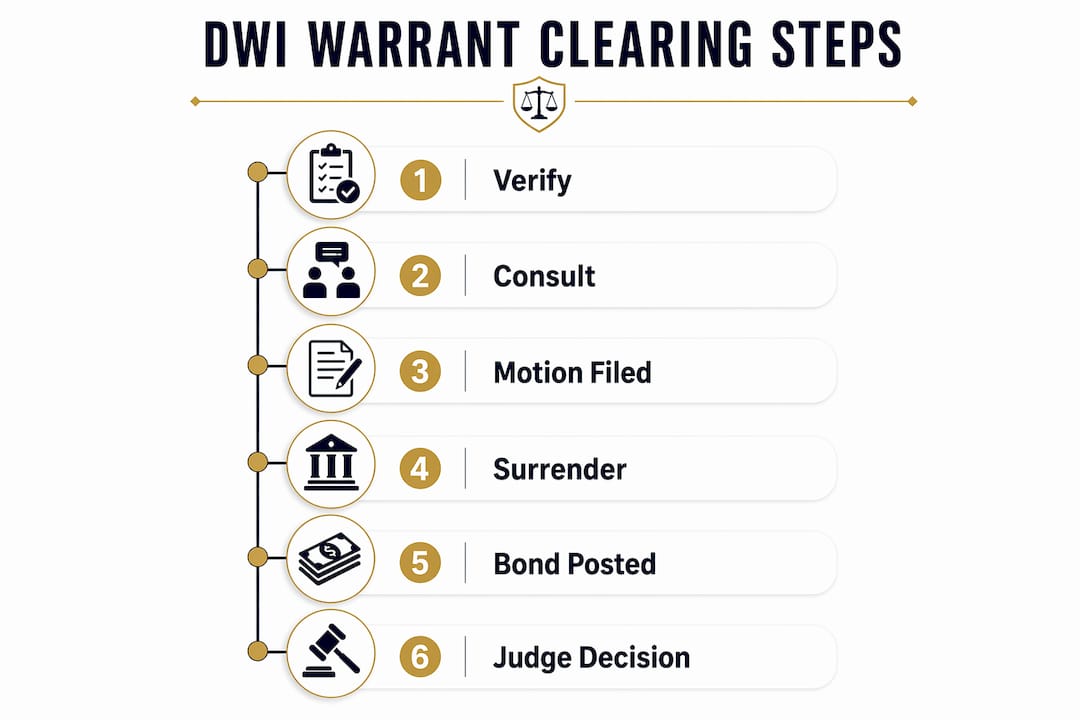
Steps to clear a DWI warrant in Texas
Once you know what you are dealing with, the process to resolve a DWI arrest warrant in Texas follows a clear sequence. Skipping steps or acting without legal counsel is where most people create bigger problems for themselves.
-
Retain a Texas DWI attorney immediately. Attorney coordination is the single factor that most consistently reduces jail time and speeds up resolution. Attorney coordination reduces risk of jail time and gives you control over how and when you surrender.
-
Determine the correct legal motion. If your bench warrant was issued because you never received proper notice of a court date, your attorney can file a Motion to Recall or Quash under Chapter 23 of the Texas Code of Criminal Procedure. A successful motion can reinstate your bond without you ever going into custody.
-
Negotiate bond conditions before surrender. Your attorney contacts the court or prosecutor to pre-arrange bond terms. Bond strategies include cash bond, surety bond, and personal recognizance bonds. Choosing the right type affects both your release conditions and how long you wait in custody.
-
Execute a walk-through surrender if required. For warrants that cannot be recalled by motion alone, an attorney-led surrender allows you to turn yourself in at a scheduled time with bond already arranged. This is far less disruptive than a surprise arrest at work or at home.
-
Confirm the warrant is cleared in court records. After surrender or motion approval, your attorney verifies the warrant is formally recalled in the court’s system. Do not assume it is cleared until you have written confirmation.
-
Open a defense file on the underlying DWI charge. Resolving the warrant addresses only the procedural failure to appear. The DWI charge itself remains active and requires its own defense strategy starting immediately.
The table below shows realistic timelines for each resolution method:
| Resolution method | Typical timeline | Custody required? |
|---|---|---|
| Motion to Recall or Quash | 24 to 72 hours | Usually no |
| Walk-through surrender | 1 to 3 days with prep | Brief, bond prearranged |
| Standard self-surrender | Unpredictable | Yes, until bond set |
| Uncoordinated arrest | Immediate, no prep | Yes, bond set by court |
Pro Tip: Many bench warrant resolutions can be completed within 24 to 72 hours when an attorney prepares the motion correctly. Acting fast after you learn about a warrant is the most direct way to minimize disruption.
Common mistakes that make clearing a DWI warrant harder
The most damaging mistake people make is doing nothing. An active DWI warrant does not fade or become less serious over time. It stays fully enforceable until a judge recalls it or officers arrest you. Ignoring a warrant increases the risk of arrest at the worst possible moment, whether during a routine traffic stop, at your workplace, or in front of your family.
The second most damaging mistake is paying a fine to “clear” the warrant without legal advice. Paying fines to resolve a warrant can be legally equivalent to pleading guilty, which creates a permanent conviction on your record. That outcome is often far worse than the original charge would have produced with proper defense.
Here are the most common errors to avoid:
- Self-surrendering without an attorney present. Courts set bond conditions on the spot when you show up unrepresented. Those conditions are almost always less favorable than what an attorney could negotiate in advance.
- Assuming the warrant only matters in the county where it was issued. Texas law allows peace officers statewide to execute any Texas warrant, so there is no safe geography.
- Treating warrant clearance as the finish line. Clearing the warrant removes the arrest order. It does not dismiss the DWI charge. Clients who stop there still face prosecution.
- Waiting for the situation to “blow over.” Active warrants appear on background checks, and employers in sensitive industries use real-time monitoring that flags new warrant activity. The professional consequences can arrive before any arrest does.
“Surrendering voluntarily with counsel present is often less disruptive and increases the chances of favorable bond terms. The difference between a controlled surrender and an uncoordinated arrest can be measured in days of lost work, family stress, and long-term record consequences.”
Comparing legal strategies for Texas DWI warrant removal
Not every warrant requires the same approach. The right strategy depends on the warrant type, the severity of the underlying DWI charge, and whether procedural errors occurred. The table below compares the three primary methods for Texas DWI warrant removal.
| Strategy | Best used when | Impact on custody | Record effect |
|---|---|---|---|
| Motion to Recall or Quash | Bench warrant issued without proper notice; procedural defect exists | No custody if granted | Warrant cleared, bond reinstated |
| Walk-through surrender | Warrant is valid; bond can be prearranged | Brief custody, bond set in advance | Warrant cleared, charge proceeds |
| Bond posting through attorney | Warrant is active; immediate release needed | Minimal custody | Warrant cleared, charge proceeds |
A Motion to Recall or Quash is the most favorable outcome because it removes the warrant without any custody at all. It applies specifically when the warrant was issued due to a procedural failure, such as a missed court date caused by lack of notice. Your attorney files the motion, the judge reviews it, and if granted, your original bond is reinstated.
Walk-through surrender is the standard path when the warrant is procedurally valid. Your attorney contacts the court, arranges bond terms in advance, and accompanies you to turn yourself in at a scheduled time. The process is controlled, brief, and far less traumatic than an unplanned arrest. For serious DWI charges like felony DWI, this coordination is especially critical because bond amounts are higher and conditions are stricter.
Bond posting through an attorney works when speed is the priority. A surety bond through a licensed bondsman can secure release quickly, though it comes with financial obligations. Personal recognizance bonds, which require no upfront payment, are sometimes available for first-time offenders with no prior failures to appear.
The underlying DWI charge shapes which strategy makes the most sense. A first-time misdemeanor DWI in Montgomery County carries different leverage than an intoxication assault case. An attorney who knows the local courts, prosecutors, and judges in Conroe or The Woodlands brings a practical advantage that no general legal guide can replicate.
Key takeaways
Clearing a DWI warrant in Texas requires attorney coordination, the right legal motion or surrender strategy, and an immediate defense plan for the underlying charge.
| Point | Details |
|---|---|
| Verify before acting | Only an attorney can obtain complete, authoritative warrant verification from court files. |
| Motion to Recall is fastest | Bench warrants issued without proper notice can often be cleared in 24 to 72 hours with no custody. |
| Never pay fines without counsel | Fine payment can trigger a permanent conviction without any legal defense. |
| Warrants enforce statewide | Any Texas peace officer can arrest you on a warrant regardless of which county issued it. |
| Warrant clearance is not case dismissal | The underlying DWI charge requires a separate, immediate defense strategy after the warrant is resolved. |
Why controlled surrender changes everything
From my experience working alongside attorneys who handle DWI warrants in Montgomery County courts, the single biggest variable in how these cases unfold is whether the client acts proactively or waits. I have seen clients who waited months, convinced the warrant would not catch up with them, only to be arrested during a routine traffic stop on I-45 with no bond arranged and no attorney present. The outcome was predictably worse on every measure: longer custody, higher bond, and a prosecutor who viewed the delay as indifference.
The clients who call an attorney the moment they learn about a warrant almost always have a better experience. Not because the legal system rewards them for it, but because preparation creates options. A Motion to Recall filed before any arrest means no custody at all. A walk-through surrender with bond prearranged means you are home the same day. Neither outcome is available to someone who waits for the system to find them.
There is also a misconception worth addressing directly. Many people believe that if they have not been arrested yet, the warrant is not a serious problem. That thinking is wrong. Open warrants appear on background checks and can cost you a job offer or a professional license before any officer ever knocks on your door. The warrant is already affecting your life. The only question is whether you address it on your terms or the court’s terms.
— Gregg
Get experienced DWI warrant help in Montgomery County

If you have an active DWI warrant in Texas, Dwimontgomery provides the focused legal support you need to resolve it without unnecessary disruption. Led by former Texas Judge and Prosecutor Mike Seiler, the firm handles warrant verification, Motion to Recall filings, bond negotiation, and walk-through surrenders for clients throughout Conroe, The Woodlands, Magnolia, and Montgomery County. Whether you are facing a misdemeanor bench warrant or a felony DWI warrant with serious consequences, the team at Dwimontgomery builds a defense strategy that addresses both the warrant and the underlying charge from day one. Contact Dwimontgomery for a confidential consultation and take control of your situation before it escalates.
FAQ
What does it mean to clear a DWI warrant in Texas?
Clearing a DWI warrant in Texas means getting a judge to formally recall or quash the active warrant so law enforcement can no longer arrest you on it. This is done through a Motion to Recall, a walk-through surrender with bond, or bond posting, depending on the warrant type.
How long does it take to resolve a DWI warrant in Texas?
Many bench warrants can be resolved within 24 to 72 hours when an attorney files a properly prepared motion. Walk-through surrenders typically take one to three days to arrange with bond prearranged.
Can I clear a DWI warrant without going to jail?
Yes, in many cases. If the warrant was issued due to a procedural defect such as lack of notice, a Motion to Recall or Quash can clear it without any custody. Even when custody is required, an attorney-led surrender with prearranged bond typically means release the same day.
Will paying a fine clear my DWI warrant in Texas?
Paying a fine may remove the warrant, but it can also function as a guilty plea, resulting in a permanent conviction on your record. Always consult a Texas DWI attorney before paying any fine related to a warrant.
Does a DWI warrant show up on a background check?
Yes. Active warrants appear on background checks and employers in sensitive industries use real-time monitoring that flags warrant activity. Resolving the warrant promptly protects both your employment and your professional licenses.
Recommended
- Boating DWI – The Seiler Law Firm
- Montgomery County DWI Lawyer | Former Judge Mike Seiler – The Seiler Law Firm
- Intoxication Assault – The Seiler Law Firm
- Underage DUI – The Seiler Law Firm
Article generated by BabyLoveGrowth